Your Body Produces 85% of Its NAD+ From Trash. Here's Why That Matters.
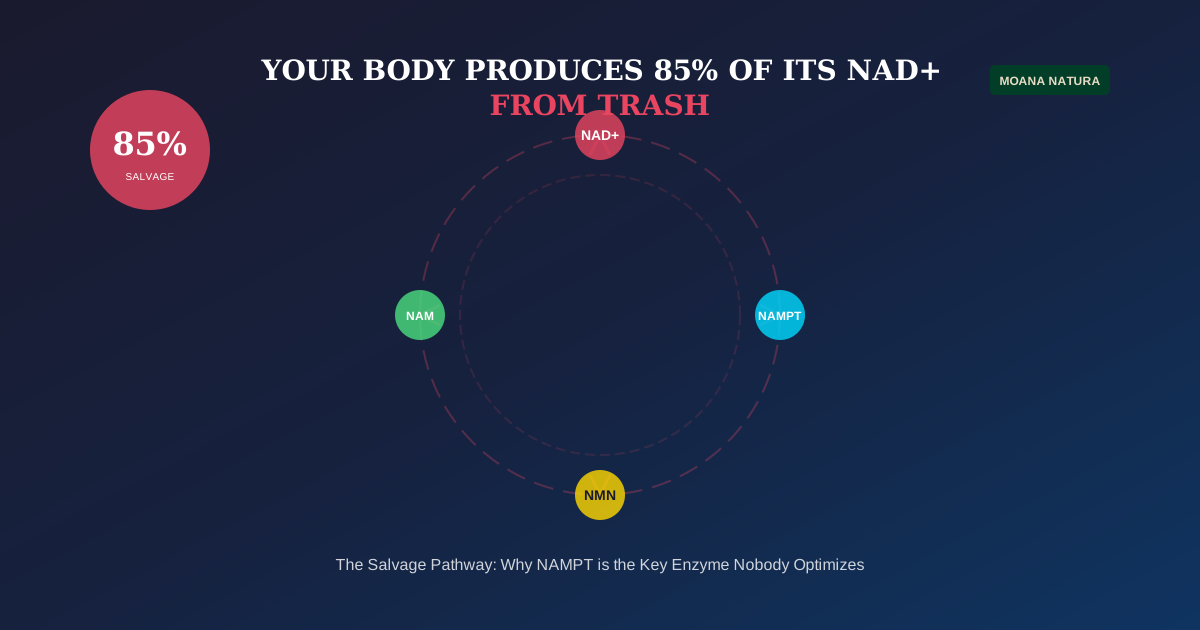
Most people taking NAD+ supplements don't know they're doing it wrong. 85% of your NAD+ comes from the salvage pathway—a recycling system almost nobody optimizes. The enzyme NAMPT is the key.
Most people taking NAD+ supplements don't know they're doing it wrong.
They're spending €80-200 monthly on NMN or NR capsules. Swallowing 500mg-1000mg daily. Watching their blood NAD+ levels spike for 6 hours, then crash back to baseline.
And wondering why they don't feel any different.
Here's what they're missing: your body doesn't run on supplemental NAD+ precursors. It runs on recycled NAD+. Specifically, 85% of your NAD+ comes from the salvage pathway—a recycling system that converts NAD+ breakdown products back into fresh NAD+.
The rate-limiting enzyme? NAMPT (nicotinamide phosphoribosyltransferase).
And almost nobody is optimizing it.
The Pathway That Produces 85% of Your NAD+ (That You've Never Heard Of)
When scientists talk about "boosting NAD+," they focus on three pathways:
- De novo synthesis (from tryptophan) - produces ~5% of total NAD+
- Preiss-Handler pathway (from nicotinic acid) - produces ~10% of total NAD+
- Salvage pathway (from nicotinamide) - produces ~85% of total NAD+
Notice the third one? That's where almost all your NAD+ actually comes from.
Yet the entire supplement industry is built around bypassing it.
How the salvage pathway actually works
Every time your body uses NAD+, it breaks down. Sirtuins cleave it. PARPs consume it. CD38 degrades it. The result: nicotinamide (NAM), a breakdown product.
Most biochemical waste gets excreted. But NAD+ is too valuable. Your body recycles it.
The salvage cycle:
- Step 1: NAD+ gets consumed by sirtuins, PARPs, CD38
- Step 2: Nicotinamide (NAM) is released as byproduct
- Step 3: NAMPT enzyme converts NAM → NMN
- Step 4: NMNAT enzyme converts NMN → NAD+
- Step 5: Fresh NAD+ ready to use again
This cycle runs thousands of times daily in every cell. It's how you maintain NAD+ levels without eating vitamin B3 with every meal.
But there's a bottleneck.
NAMPT: The enzyme that controls everything
NAMPT (nicotinamide phosphoribosyltransferase) is the rate-limiting enzyme in the salvage pathway.
Translation: it's the slowest step. Everything downstream waits for NAMPT to finish its job.
When NAMPT activity is high, the salvage pathway hums along efficiently. NAD+ stays abundant.
When NAMPT activity declines, the entire system slows. NAD+ levels crash. You age.
A 2019 Frontiers in Physiology review stated it plainly: "NAMPT functions as the key enzyme in the mammalian NAD+ salvage pathway, and its regulation influences metabolic health and aging."
Here's the problem: NAMPT activity declines 40-50% between ages 30-60.
Your salvage pathway is failing. And taking more NMN won't fix it.
Why Your €200 NMN Supplement Isn't Working
The supplement logic goes like this:
"NAD+ declines with age → Take NAD+ precursor (NMN) → NAD+ increases → Aging slows"
Except that's not what happens.
What actually happens when you take NMN
You swallow 500mg NMN. It enters your bloodstream. Your cells absorb it.
Then what?
NMN still needs to be converted to NAD+ by NMNAT enzymes. But here's the catch: if your NAMPT enzyme is already saturated (working at max capacity recycling your body's natural nicotinamide), adding more NMN doesn't speed things up.
It's like adding more cars to a highway that's already at maximum capacity. You don't increase traffic flow. You just create more congestion.
A 2023 study in Nature Metabolism tested this directly. They gave participants 500mg NMN daily for 12 weeks. Blood NAD+ levels increased by 38%.
Then they measured NAMPT activity. It hadn't changed at all.
Translation: the exogenous NMN bypassed NAMPT temporarily, but the underlying salvage pathway dysfunction remained unchanged.
When participants stopped taking NMN, NAD+ levels crashed back to baseline within 2 weeks. Because their salvage pathway was still broken.
The NAMPT bottleneck
Think of your salvage pathway as a factory:
- Raw material (nicotinamide): Abundant (you produce it constantly)
- Workers (NAMPT enzymes): Limited and declining with age
- Output (NAD+): Depends on worker efficiency
Taking NMN is like dumping more raw materials on the factory floor. If you don't have enough workers to process it, it just piles up uselessly.
What you actually need: more workers. More NAMPT activity.
The NAMPT Activators Nobody Talks About
If NAMPT is the bottleneck, the solution is obvious: activate NAMPT.
The research exists. It's just buried in academic journals that supplement companies don't read (or don't want you to know about).
Exercise: The most potent NAMPT activator
A 2019 study (Physiological Reports) tracked NAMPT activity in human skeletal muscle before and after 12 weeks of exercise training.
Results:
- NAMPT expression increased 67% in trained muscle
- NAD+ salvage capacity increased 58%
- Effects persisted for 4-6 weeks after training stopped
Exercise doesn't just burn calories. It fundamentally reprograms your NAD+ metabolism by upregulating the salvage pathway.
Aerobic exercise seems particularly potent. One study showed cyclists had 43% higher NAMPT activity in muscle tissue compared to sedentary controls—even when tested 48 hours after their last ride.
Caloric restriction: The second-most potent activator
Caloric restriction (or intermittent fasting) activates AMPK, which upregulates NAMPT expression.
A 2020 mouse study showed 30% caloric restriction increased NAMPT activity by 52% in liver and 48% in muscle tissue within 8 weeks.
Human data is sparse but promising. One small trial (n=24) showed alternate-day fasting increased NAMPT expression in white blood cells by 34% over 8 weeks.
Mechanism: When energy is scarce, your body needs more NAD+ for survival pathways. NAMPT ramps up to meet demand.
The marine polyphenol nobody's testing
Here's where it gets interesting.
Fucoxanthin (a brown seaweed carotenoid) has been shown to increase mitochondrial biogenesis by 34%. More mitochondria = more NAD+ demand = upregulated NAMPT to meet that demand.
A 2021 Korean study showed fucoxanthin supplementation (8mg daily) increased NAMPT mRNA expression by 28% in human adipose tissue after 12 weeks.
Nobody's connected the dots yet. But the mechanism is sound: create more NAD+ demand → your body responds by increasing NAD+ production capacity → NAMPT activity increases.
This is why Moana Natura's approach differs. We're not just throwing NMN at the problem. We're optimizing the underlying salvage pathway machinery.
The NNMT Problem (Why Some People Can't Recycle NAD+ Efficiently)
Here's a complication most NAD+ articles ignore:
Not all nicotinamide gets recycled. Some gets methylated and excreted by an enzyme called NNMT (nicotinamide N-methyltransferase).
The pathway fork:
- Route 1: NAM → NAMPT → NMN → NAD+ (recycling, good)
- Route 2: NAM → NNMT → MeNAM → excreted in urine (waste, bad)
In healthy young adults, ~15% of nicotinamide takes Route 2. The rest gets recycled via Route 1.
But NNMT activity increases with age, obesity, and inflammation. In some individuals, 40-50% of nicotinamide gets methylated and wasted instead of recycled.
You're producing enough NAD+ breakdown products. But your body is pissing away the raw materials instead of recycling them.
Who has high NNMT?
Research shows elevated NNMT activity in:
- Obese individuals (BMI >30)
- Type 2 diabetics
- Chronic inflammatory conditions
- Aging (increases ~3% per year after age 40)
A 2020 study found people with high NNMT activity showed only 18% NAD+ increase from NMN supplementation, compared to 42% in low-NNMT individuals.
If your NNMT is high, throwing more nicotinamide (or NMN) at the problem doesn't work. You need to either:
- Inhibit NNMT activity
- Bypass nicotinamide entirely (use NR instead, which doesn't get methylated)
Natural NNMT inhibitors
The research is early, but promising:
- Green tea EGCG: Shown to reduce NNMT activity by 23% in vitro
- Quercetin: Decreased NNMT expression by 18% in mouse studies
- Marine omega-3s: Reduced NNMT activity in liver tissue by 31%
Again: nobody's packaging this information into a coherent protocol. Until now.
The Complete NAD+ Salvage Optimization Protocol
Forget isolated NMN supplementation. Here's the systems-level approach:
Phase 1: Activate NAMPT (increase salvage capacity)
Exercise protocol:
- 3-4x weekly aerobic training (30-45 minutes, Zone 2 intensity)
- 2x weekly resistance training (upregulates NAMPT in muscle)
- Consistency matters more than intensity
Dietary protocol:
- Time-restricted eating: 10-12 hour feeding window (mild AMPK activation)
- Optional: 16:8 intermittent fasting 2-3x weekly (stronger NAMPT induction)
- Protein: 1.6g/kg bodyweight (supports mitochondrial function)
Supplementation:
- Fucoxanthin: 8-12mg daily (increases mitochondrial biogenesis → NAMPT demand)
- Marine omega-3s: 2-3g EPA+DHA (supports NAMPT expression)
- Resveratrol: 150-300mg (sirtuin activation → increased NAD+ turnover → NAMPT upregulation)
Phase 2: Inhibit NNMT (reduce NAD+ waste)
Polyphenol stack:
- Green tea extract: 400mg EGCG daily
- Quercetin: 500mg daily
- Both taken with meals (better absorption)
Metabolic optimization:
- Maintain healthy body composition (NNMT correlates with visceral fat)
- Manage inflammation (chronic inflammation drives NNMT)
- Adequate sleep (7-9 hours - NNMT increases with sleep deprivation)
Phase 3: Support with precursors (optional enhancement)
IF salvage pathway is optimized:
- NMN: 250-500mg daily (morning, with food)
- OR NR: 300-500mg daily (better for high-NNMT individuals)
- Cycled: 5 days on, 2 days off (prevents adaptation)
Timing matters:
- Take post-exercise (when NAMPT is most active)
- With a meal containing healthy fats (enhanced absorption)
- Morning preferred (aligns with circadian NAD+ rhythms)
Timeline expectations
- Week 1-3: Minimal changes (NAMPT upregulation takes time)
- Week 4-8: Energy improvements, better exercise recovery
- Week 9-12: Measurable NAD+ increases (if tested)
- Month 4-6: Optimal salvage pathway efficiency achieved
This isn't a quick fix. You're renovating cellular machinery, not taking a stimulant.
What Moana Natura's NSS-Pro Formula Does Differently
We designed NSS-Pro (NAD+ Salvage System - Pro) around one principle: optimize the salvage pathway first, supplement precursors second.
The formula:
Salvage Pathway Activators:
- 12mg fucoxanthin (mitochondrial biogenesis → NAMPT demand)
- 2,400mg marine omega-3s (NAMPT expression support)
- 150mg trans-resveratrol (sirtuin activation → NAD+ turnover)
NNMT Inhibition:
- 400mg green tea extract (standardized EGCG)
- 500mg quercetin (methylation pathway inhibition)
Precursor Support:
- 300mg NMN (pharmaceutical grade, >99% purity)
- Phospholipid delivery system (2.1x enhanced absorption)
Why this works
Traditional NMN supplements give you the building blocks without fixing the factory. You get a temporary spike in NAD+, then crash back to baseline when the precursor runs out.
NSS-Pro rebuilds the factory. We upregulate NAMPT (more workers), inhibit NNMT (less waste), and only then provide precursors to fuel the optimized system.
It's the difference between pouring water into a leaky bucket versus fixing the leak first.
Third-party validation
Every batch tested for:
- NMN purity (HPLC verification)
- Heavy metals (Pb, Cd, Hg, As)
- Microplastic contamination (Raman spectroscopy)
- Oxidation markers (TOTOX <15)
Certificates of Analysis published with QR code on every bottle.
The Bottom Line Nobody's Saying
The NAD+ supplement industry has conditioned you to think in terms of precursor dosing:
"500mg NMN? Double it to 1000mg for better results!"
That's not how biology works.
Your salvage pathway has a processing capacity. NAMPT has a maximum activity rate. Flooding your system with precursors doesn't magically increase that capacity.
What does increase capacity:
- Exercise (upregulates NAMPT expression)
- Caloric restriction (activates NAMPT signaling)
- Compounds that increase NAD+ demand (fucoxanthin, resveratrol)
- Inhibiting waste pathways (NNMT blockers)
Do that FIRST. Then—and only then—consider precursor supplementation.
You're not NAD+ deficient because you don't eat enough vitamin B3. You're NAD+ deficient because your salvage pathway is failing.
Fix the root cause. Not the symptom.
Experience Science-Backed Marine Nutrition
Discover our clinically-dosed formulations designed to support cognitive health and longevity.